Showing posts with label Indiana Jones. Show all posts

Saturday, August 30, 2008

John Williams, Redux

This summer of 2008 will be most memorable to me because once again I spent a night at a definitive Los Angeles landmark - the symbolic Hollywood Bowl - and with the single greatest force in film music - the incomparable John Williams!

To see him perform live is an experience like no other. His singular ability to capture the beauty, drama, excitement, humor, and even terror in film through music is mind-blowing.

It's nothing short of masterful how his numerous film scores have stood the test of time being distinctively iconic and universally recognizable. This year's concert title aptly puts it in perspective - "John Williams: A Hollywood Legend".

I thoroughly enjoyed "John Williams: Maestro of the Movies" last year that I made a pact to go on a pilgrimage to see John Williams make magical movie music every summer at the Bowl.

With the country freshly relishing its victory in the recent Beijing Olympics, John Williams opened the night with a tribute to the Olympic Games. And he started with a most fitting piece - the jubilant "Olympic Fanfare and Theme" which he himself composed and conducted for the 1984 Los Angeles Olympics.


A reflective interlude followed with "Song for World Peace," a most lyrical and symbolic piece that focused on flute and violin - instruments that reflected notions of tranquility. The three-piece opening salvo was concluded with "The Olympic Spirit" that featured film clips of past and most recent Olympic victories.

Williams perhaps never fails to mention his 35 years of collaboration with film director Steven Spielberg at each concert that he likens their relationship to a good marriage of movie and music that had always been harmonious in artistic expression.

So, he summed up the first half of the concert with music from their countless collaboration: Excerpts from "Close Encounters of the Third Kind" (1977); "Flight to Neverland" from "Hook" (1991); "The Adventures of Mutt" and "Irina's Theme" from "Indiana Jones and the Kingdom of the Crystal Skull" (2008); and "Raiders March" from "Raiders of the Lost Ark" (1981).

The second half of the concert dubbed "Hooray for Hollywood" started with a tribute to American film director and choreographer Stanley Donen whose body of work includes "Seven Brides for Seven Brothers" (1954), "Always Fair Weather" (1955) and "Singin' In The Rain" (1952). As Williams' special guest, he provided lively banter and interesting insights into his featured films.

Most notable technological insights were how Fred Astaire was made to appear seamlessly dancing on walls and the ceiling singing "You're All The World To Me" in the 1950 film "Royal Wedding," and the challenges met by Donen in fusing live action with animation in "The Worry Song" from the 1945 musical "Anchors Aweigh". These are amazing feats of technical triumph considering they were made during Hollywood's golden age.

Williams next conducted his score for the 1995 remake of the Audrey Hepburn 1954 classic "Sabrina". The orchestra featured critically-acclaimed violin soloist Bing Wang.

The last part of the second half was a fitting tribute to George Lucas and Steven Spielberg. Williams started with the eerie theme from "Jaws" (1975) which seamlessly segued to the victorious theme from "Star Wars" (1977).
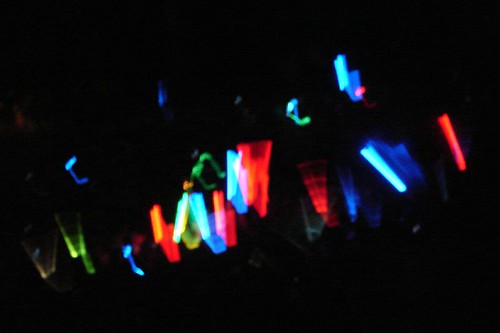
This summer, I came prepared with a toy lightsaber and joined other fanatics light up the dark ampitheater with our neon "weapons". He capped the tribute with his soaring and Academy award-winning score for "E.T. - the Extra-Terrestrial" (1982).

What's a concert without an encore? After bowing out of the stage, the spotlight found him front and center again. The orchestra blasted away with the main theme from "The Empire Strikes Back" (1980) which found the faux lightsabers and hollers of adulation back in the air!

"Marion's Theme" followed as a tribute to the character popularized by Karen Allen which made a comeback in the fourth installment of the Indiana Jones movies. The encore was fittingly concluded by the triumphant march from "Superman" (1978).

Another great summer night with the most important composer of our time.

I can't wait for next summer.

Thursday, August 30, 2007

The Force is with John Williams

None in my new immediate circle of friends knew who John Williams is, so I set myself up for a "solitary" night of movies music with Hollywood's most accomplished and acclaimed film scorer. Having no car, I took the red line and alighted at Hollywood & Highland where a shuttle to Hollywood Bowl was waiting - plus a complimentary beverage of your choice from Starbucks.

It was my first time at the Bowl and no one better to raise the curtains for me but a film artist whose work I have tremendously admired and religiously followed since childhood, being oriented to his masterful works through his soaring and award-winning score for E.T. the Extra-Terrestrial (1982). His many collaborations with filmmaker Steven Spielberg, an artist I hold in equal esteem, provided nourishment to my soul growing up in an environment where access to and expression through art was limited.

The mood was festive as the bus pulled up near the box office. Clusters of people camped on the lawns enjoying a little pre-concert picnic; some laid out blankets, others folded out collapsible chairs, and there were those who chose to commune with nature by ensconcing themselves on the gentle, green grass. Wine sampling booths added boost, or should I say booze, to the occassion.

The humungous ampitheatre was abuzz with activity as I entered. I was amazed at the sheer volume of people in attendance. I couldn't help but say to myself, "So this many people know who John Williams is? I must be hanging out with the wrong crowd."

Activity and its accompanying noise gradually dissipated as the lights faded out, the crowd waiting in anticipation for the appearance of the man of the show. The great John Williams received warm applause as he entered the stage. He started the show as soon as he stood on the pedestal.

Act One was an homage to film composers of Hollywood's Golden Age. He offered his own rendition to some of the finest compositions during the era which served as inspiration for his works: Miklos Rozsa's "Parade of the Charioteers" from Ben-Hur (1959), Erich Wolfgang Korngold's "March" from The Adventures of Robin Hood (1938), Bernard Herman's "Scene d'Amour" from Vertigo (1958), themes from Gone With the Wind (1939) and Now, Voyager (1942) by Max Steiner, and Maurice Jarre's scores for director David Lean's Dr. Zhivago (1965) and Lawrence of Arabia (1962); the last two with excerpts from the movie.

Watching John Williams perform live was a dream within reach when I came to America, and I could not believe I was fulfilling that dream that night as the concert unfolded. I was wide-eyed amazed at the man whose work I have loved from such a long distance, relishing his work from a creaky audio cassette player and expressing admiration by telling people about his work as I listen to his music or while walking out of a theater after watching a movie he scored.

Act Two was dedicated to the man of the show, and his opening salvo was the iconic heroic "March" from director Richard Donner's Superman (1978). The crowd went wild as the orchestra blasted the first five notes of the piece. Goosebumps crawled up from my ankles to my nape. He followed it up with the accompanying "Love Theme", an instrumental version of the song "Can You Read My Mind?" which he also composed.

His underappreciated score for Catch Me If You Can (2002) is most distinctive and surprising for a Steven Spielberg film. I honestly did not retain the tune after watching it unlike most of his collaborations with Steven Spielberg. But listening to "Closing In," "Reflections," and "Joyride" with live alto saxophone, vibraphone and bass accompaniment provided me new opportunity for appraisal.

Three pieces from the Harry Potter movies followed, evidence of his successful reinvention that has allowed him to connect with the millennium generation. He began with the atmospherically eerie "Chamber of Secrets" from Harry Potter and the Chamber of Secrets (2002); segued to "Aunt Marge's Waltz" from Harry Portter and the Prisoner of Azkaban (2004) that brimmed with mischievous bouyancy; and concluded with a sumptous summation of fantasy and wonderment through "Harry's Wondrous World" from Harry Potter and the Sorcerer's Stone (2001) .

As the orchestra began to blast with the triumpaht "Throne Room and Finale" from Star Wars Episode IV: A New Hope (1977) the dark ampitheatre lit up with faux lightsabers. Fans of the man and the movie brandished the trademark weapon in the air throughout the whole piece. It was an exercise of unbridled fanaticism.

An encore was definitely in the offing as he waved the audience goodbye. The spotlight followed his exit and stayed right at the door. As he reentered the stage, the crowd gave a loud applause and took a while to sette. He delivered his encore with a bang starting off with the spellbinding main theme from Star Wars Episode V: The Empire Strikes Back (1980). He followed it up with "Sayuri's Theme" from Memoirs of a Geisha (2005), a movie I have yet to see. The piece unfolded like a romantic rhapsody of melancholy and joy.

Everyone was up on their feet as he exited the stage again - only to come back to appease the people's clamor for his immediate return. To my delight his third encore piece was the main theme from "E.T. the Extra-Terrestrial". I roared out adulation in a heartbeat, and was a tad embarassed realizing it was the only cry of admiration heard throughout the huge ampitheatre. It seemed I was the only one who recognized the first few playful notes of the piece.

The audience's thirst for his music was unquenable that cheers crescendoed again as he walked off the pedestal and out of the stage for the third time. And the shouts of approval and encouragement persisted. The fans just wouldn't let him go. And to return his audience's appreciation, the artist returned to the stage. A fourth encore piece! Now that's a concert! He capped the night of musical adventure with a most befitting piece - the main theme from the Indiana Jones trilogy.

As the music faded out, applause was again fading in. John Williams, beaming with gratitude at the appraisal endowed him, stood still for a moment smiling at the populace before him. It has been almost three hours since the concert started. He put his palms together and rested his right cheek on them as he tilted his head to the side gesturing sleep. The crowd broke into laughter and clapped their hands firmly as if letting him go. And he exited. Stagelights dimmed and floodlights filled the ampitheatre.

Excitement brewed anew as the crowd marvelled about the concert while walking out - from the ramps, to the parking lot, and even to the train station. John Williams, along with the L.A. Philharmonic Orchestra, may have bowed out for the night, but the little evening of wonderful music will remain in the minds and hearts of the audience for a long time.